
 13. Deaf Museums and Their Locations
To the Table of Contents
4 of 5 (2 Votes)

Intro Chapter 13
Most Deaf Museums in Europe are located at a School for the Deaf. Their stories and exhibits often focus on the history of the school. Other Deaf Museums have found other locations: a Deaf Club or Deaf organisation, or some other building.
Costs are often high, the future is uncertain. Some Deaf Museums experiment with alternative locations.
13.1 Location: A School for the Deaf
Several Deaf Museums are located in old, or still functioning, schools for the Deaf. This has an advantage: the buildings themselves are part of the Deaf Heritage and some are historic landmarks.
The risks are high, too. The schools in Trondheim and in St. Michielsgestel are no longer used as schools for the deaf. In Trondheim, the Deaf community fought to keep at least part of the building (one floor) available for the Deaf Museum. In St. Michielsgestel, the Museum of Deaf Education had to close its doors when the building was sold in 2021.
The Museum of Deaf History and Culture, Trondheim, Norway
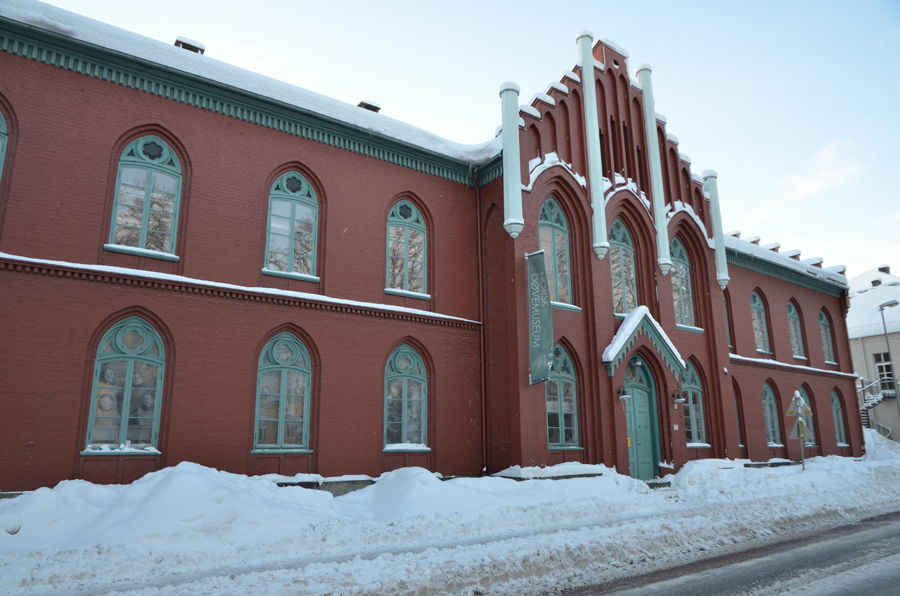
The building on Rødbygget (Red Building) had been a school for the deaf ever since it was completed in 1855. In this building, the Trondheim Deaf Association was founded in 1898 and the Norwegian Deaf Association in 1918.
In 1991, the school for the deaf in Trondheim moved to new premises outside the city. In 1990 a foundation had been established with the objective that Rødbygget would become a national museum of deaf history. But in December 1990, the government decided that the entire area of Bispegata 9B, of which Rødbygget was a part, was to become part of Trondheim University College of Engineering.
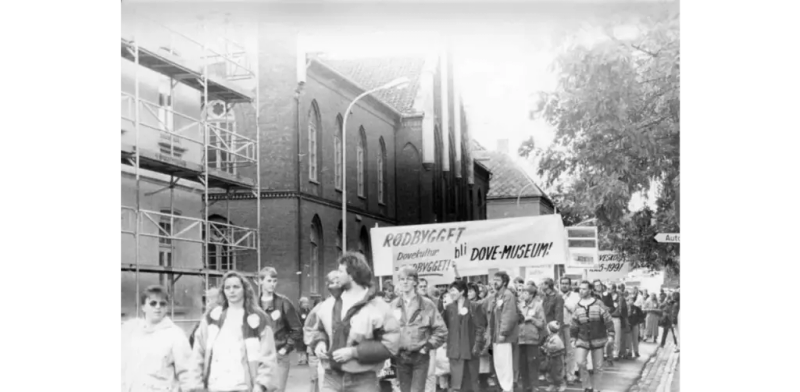
In the autumn of 1991, deaf people from all over the country gathered in Trondheim for the Deaf Culture Days. A demonstration was held through the city streets. 500 demonstrators participated in support of the Red Rødbygget becoming a museum.
The College of Engineering agreed to rent space for a Deaf Museum. but the costs were sky high. To be able to pay the high rent, the Norwegian Deaf Museum became part of Trøndelag Folk Museum in 2002. source: https://norsk-dovemuseum.no/organisasjoner
Since 2009 the museum occupies the whole first floor of this building, there is a cafeteria, an archive/library and 4 modern exhibition rooms.
The building is a protected building, which means that the Museum is not allowed to interfere with any of the interior. There are also other organisations renting areas in the building. This makes it difficult to make good advertising for the entrance of the museum.
Museum of Deaf Education, Sint Michielsgestel, NL
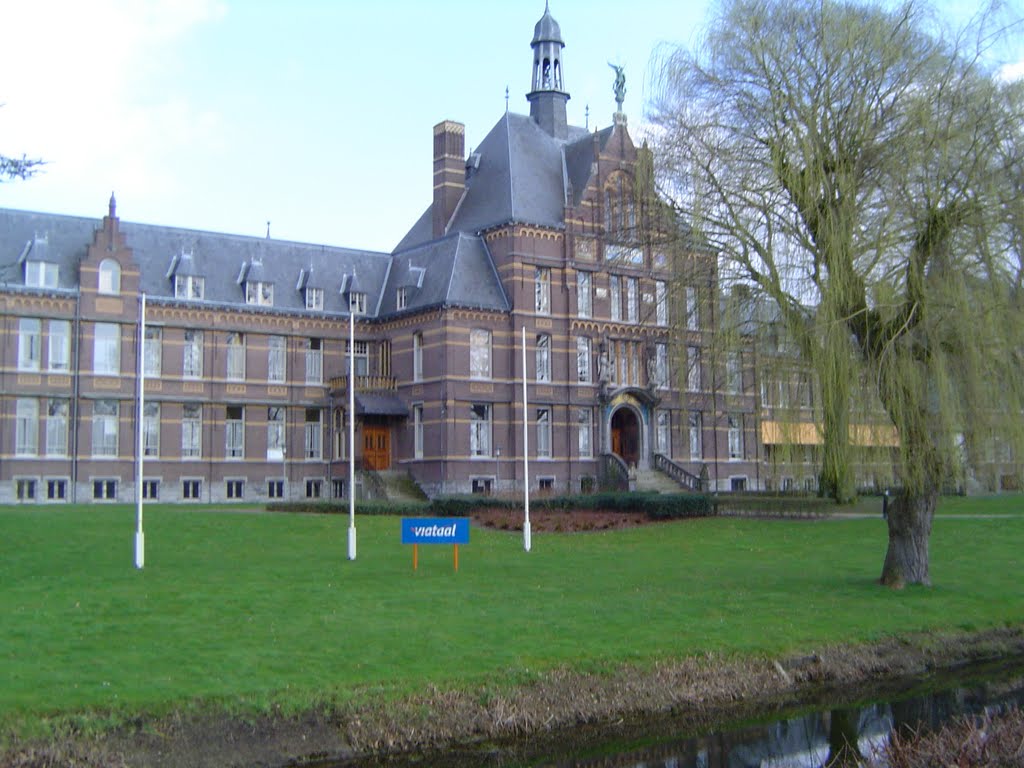
The Museum of Deaf Education in the Netherlands was located in one of the chapels of the old School for the Deaf in St. Michielsgestel. In 2021, the building was put up for sale. The Museum was closed, all exhibits are now stored in containers, waiting for better times and a new location.

The Danish Deaf History Society
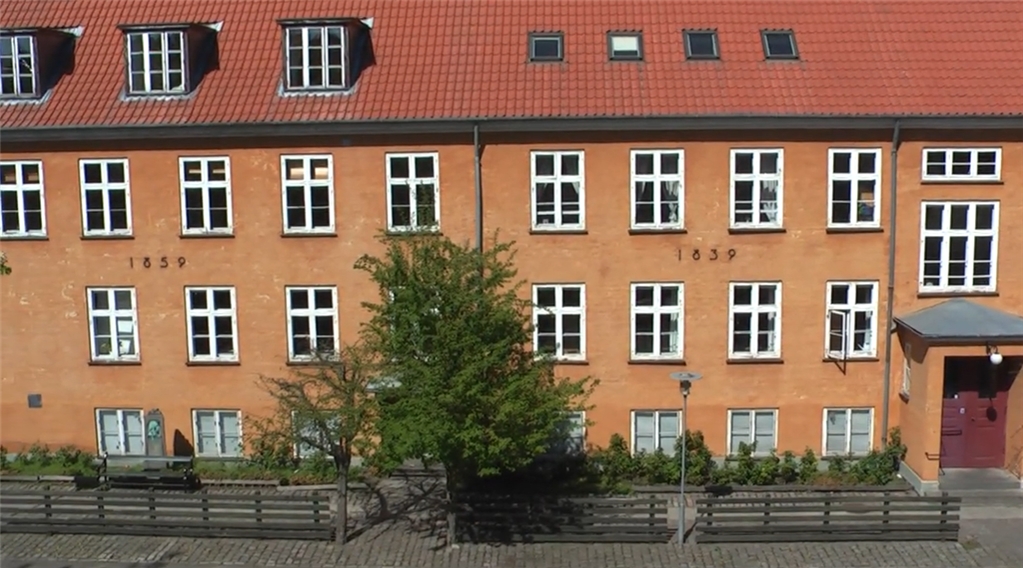
Døvehistorisk Selskab, in English: The Danish Deaf History Society, has a small museum in the still functioning School for the Deaf in Copenhagen (DK), see https://www.deafmuseums.eu/index.php/en/deaf-museums/europe/item/dovehistorisk-selskabdanish-deaf-history-society. In the school, the Museum has 4 rooms (200m2 area). Rent is free.
The Tommaso Pendola Museum , Italy

The headquarters of the former School for the Deaf in Siena now houses a museum dedicated to the school, full of handicrafts made by pupils and specific equipment used in the classroom.

13.3. A Virtual Deaf Museum
to be written
13.2. Location: a Historic Monument

Musée d'Histoire et de Culture des Sourds
The Museum is located in the outbuildings of the Hôtel-Dieu de Louhans. The Hôtel-Dieu de Louhans is a historic building. It was a hospital establishment built between 1682 and 1686 . Until its closure in 1977 , the nuns of the Order of Saint Martha provided care for the sick.
The building is made available to the Deaf Museum, free of charge, but the Museum pays the charges: electricity, water, heating, telephone (Internet).

13.3. Location: a Deaf Club or Organization

Finnish Museum of the Deaf, Kuurojen Museo
The Finnish Museum of the Deaf is located in the Lighthouse, the headquarters of the Finnish Association of the Deaf in Helsinki. The Museum operates as part of the Finnish Labour Museum in Tampere.

The exhibition space at the Lighthouse in Helsinki
The British Deaf Museum & Archive
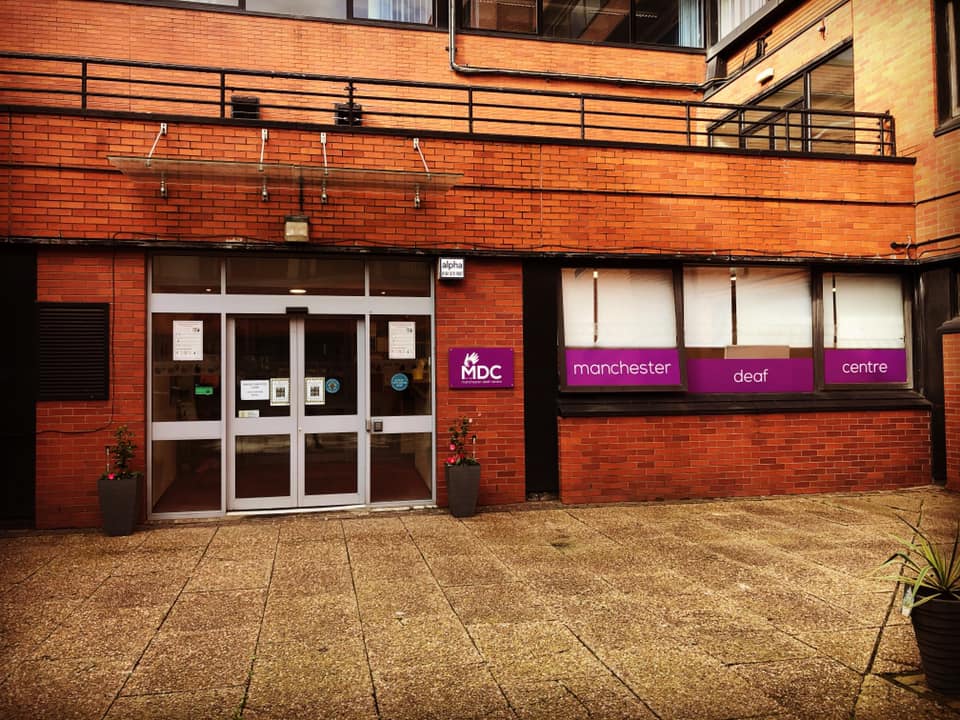
The British Deaf Museum is located at the Manchester Deaf Centre. The Museum rents the space for appr. £1600 pm.
13.3. A Virtual Deaf Museum
Both the Finnish Museum of the Deaf and more recently, the Deaf Heritage Centre in the UK use a virtual online Museum in addition to their physical exhibitions.
The Virtual Museum of the Finnish Museum of the Deaf
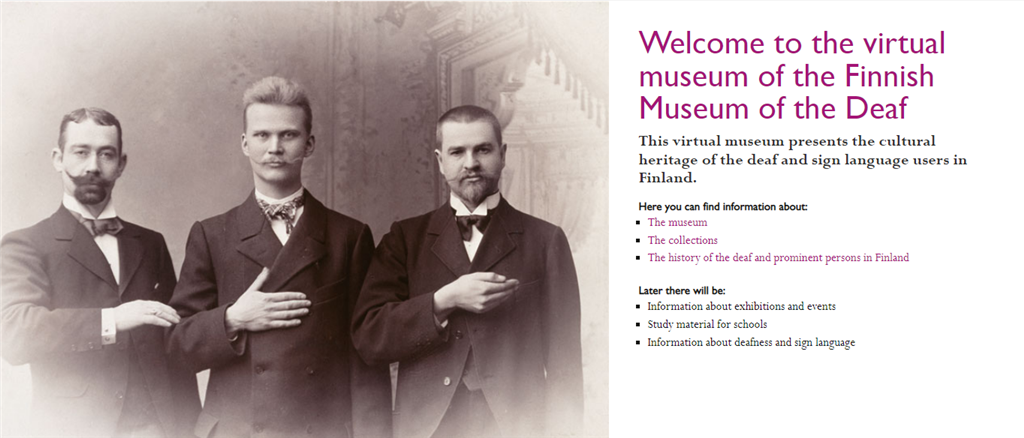
The physical Deaf Museum in Helsinki has about 2.000 visitors per year (before Covid-19 restrictions). The web museum has 20.000-40.000 visitors per year - from across the world.
UK: Deaf Heritage Centre
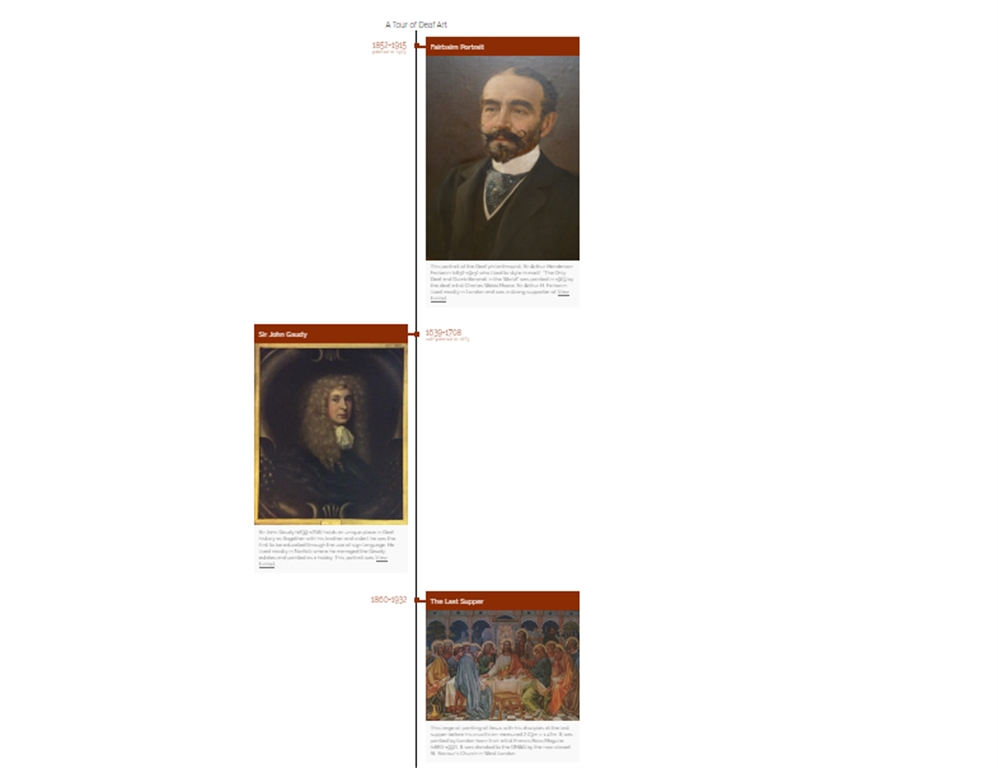
The Deaf Heritage Centre has a number of online exhibitions on its website, with photos of its physical exhibitions. For instance: A Tour of Deaf Art, and A Deaf History in 50 Objects. https://www.bdhs.org.uk/a-deaf-history-in-50-objects/
Deafscotland: Virtual Deaf Museum
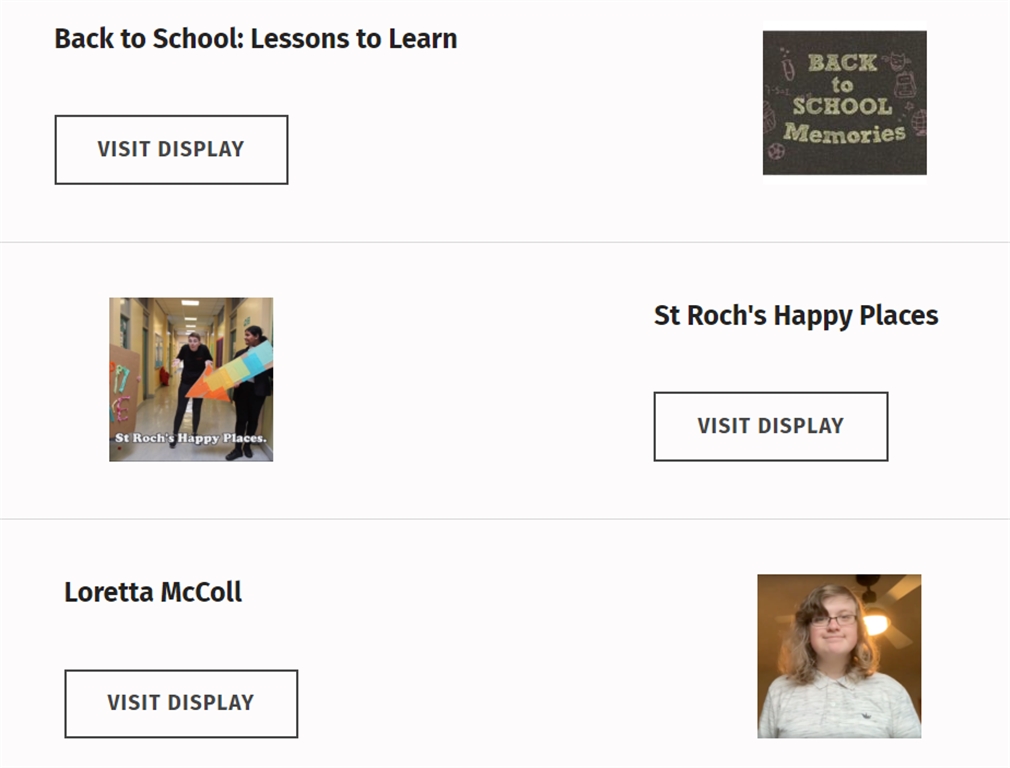
Deafscotland's Virtual Museum was funded by the National Lottery Heritage Fund. It is a living archive dedicated to the heritage and culture of deafness in Scotland. deafscotland covers the four pillars of deafness – Deaf including British Sign Language (BSL) users, Deafblind, Deafened and Hard of Hearing.
The virtual Museum is located on the website of deafscotland. It has a basic lay-out with limited interactivity.
Souce: https://deafscotland.org/virtual-museum-info/
13.5. Location: a Mainstream Museum
The Deaf Museums in Norway and Finland are both part of a mainstream Museum. But the actual exhibitions have their own locations. The Deaf Museum in Norway rents a floor of the old Deaf school in Trondheim. The Deaf Museum in Finland is located at the building of the national Finnish Federation of the Deaf.
In both cases, the curators are hearing. In our survey of Deaf Museums we asked our contact persons if the people working at the Museum received any special training. The other contact persons responded: yes, volunteers had had training in museum skills, cataloguing or archiving. The contact person of the Deaf Museum in Norway responded that people working at the Museum were offered training in sign language.
At the moment, the Museum is looking for a new curator - on the Facebook pages, there is some discussion if it is a requirement that the new curator knows Norwegian sign language, and if not: how the costs of interpreters will be covered. The story of the start of this Museum also shows that collaboration between the Deaf community and a mainstream Museum is not always easy and will take time.
"This chapter focuses on the problems and challenges encountered by seasoned museum workers when confronted with disability issues, challenges around the uses of sign language and the dilemmas thrown up by politicized distinctions between an understanding of deafness (as disability) versus Deafness as culture."
Hanna Mellemsether, A Museum for All? 2010
Deaf Exhibitions at Mainstream Museums
-
France: The Silent History of the Deaf, Histoire silencieuse des Sourds
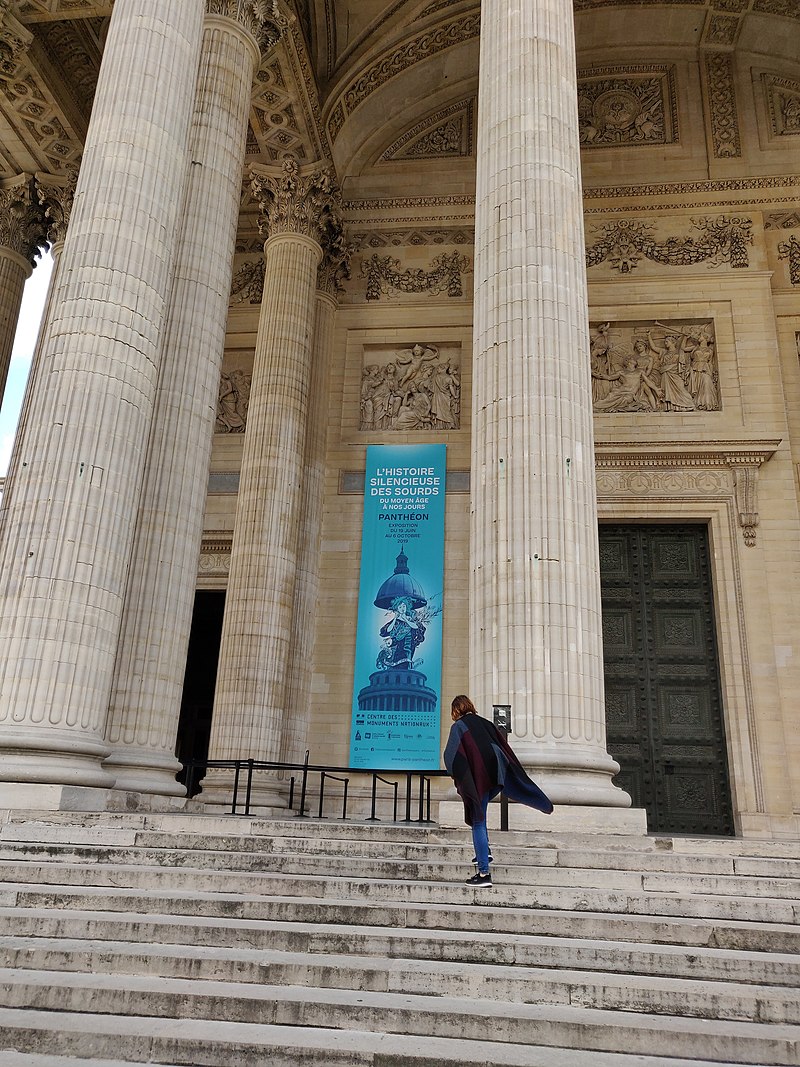
The Silent History of the Deaf was an exhibition on deaf history and French sign language. taking place from June 19, 2019 to October 6, 2019 at the Panthéon in Paris.
It was "an introduction to the history of the Deaf with its periods of progress for education and integration, its great figures of educated and committed deaf-mutes like Jeanne Stuart or the architect Étienne de Fay, the creation of the first deaf association in Paris in 1836 by Ferdinand Berthier [as well as] its periods of regression, with the rise of eugenics at the end of the 19th century and in the 20th century”.
Yann Cantin, doctor in History at the School of Advanced Studies in Social Sciences (EHESS) and lecturer at the Paris-VIII University of Vincennes-Saint-Denis, presented the exhibition as scientific curator, thanks to the support the Center des Monuments Nationaux, the National Institute for Deaf Youth, the International Visual Theater and the Friends of Abbé de L'Épée association.
The first preparations began around 2015 when the association Les Amis de l'Abbé de l'Epée made a request for the pantheonization of the Abbé de l'Epée. Faced with the difficulties of doing so, in particular the presence of the remains of the abbot in the church of St-Roch, Philippe Bélaval proposed the idea of organising an exhibition at the Panthéon. After reflection, the year 2019 was chosen.
In July 2019, Yann Cantin joined the team to organise the exhibition as curator. He proposed to structure the exhibition chronologically from the Middle Ages to the present day, highlighting the most important aspects of deaf historiography.
The exhibition was inaugurated on July 18, 2019 in front of more than 800 guests from different backgrounds. It was the first time that a speech was delivered there in LSF.
The exhibition was organised in chronological sections with
-
- Discovering the Roots,
- Towards Recognition,
- Towards Rejection,
- Le Réveil Sourd,
on a circle of panels surrounding a central column where four videos are projected presenting deaf personalities, played by actors deaf: Madeleine Le Mansois, Ferdinand Berthier, Henri Gaillard and Emmanuelle Laborit (played by herself).
source: https://fr.wikipedia.org/wiki/L%27Histoire_silencieuse_des_Sourds , translated from French by Google Translate

-
Australia: Expressing Ourselves
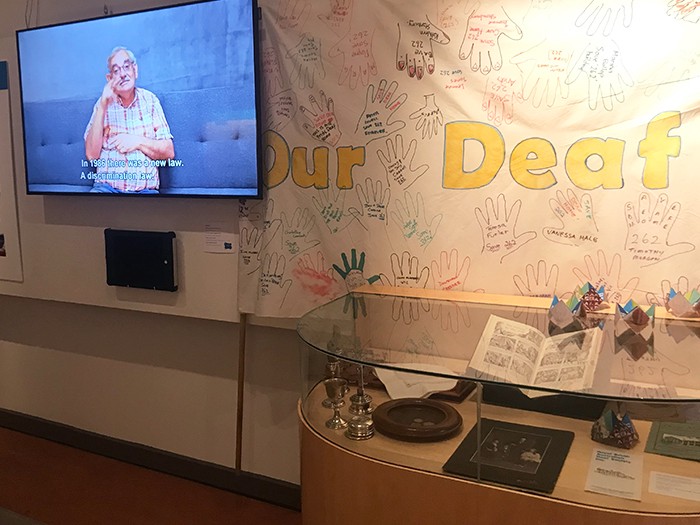
"In September 2020 the History Trust of South Australia’s Migration Museum was proud to welcome over a hundred members of the South Australian Deaf community to the opening of the community-driven exhibition Expressing ourselves: being Deaf in SA in our Forum gallery.
This opening was the culmination of two years of relationship building, negotiation, discovery, learning and hard work on the part of the Deaf exhibition development committee and Migration Museum curators. How and why did this exhibition come about, and what did we learn as museum professionals along the way?
To further our understanding of Deaf language (and get a basic introduction to Deaf culture), later that year, myself and other museum staff took a six-week Australian Sign Language course organised through our colleagues at the South Australian Museum. The class was taught ‘voices off’ (no speaking) by a Deaf teacher from Deaf Can:Do, formerly the Royal South Australian Deaf Society, and a primary provider to the Deaf community in South Australia. I discussed with our teacher how we could better include Deaf people in the museum and she facilitated a meeting with community members who might be interested in developing a Forum exhibition.
Before that first meeting my (somewhat reductive and naive) thought was that, similar to the Deaf exhibitions overseas mentioned above, the Forum exhibition might be about Auslan and its role in Deaf life. As a hearing person this made sense to me and seemed to fit with the Forum as a place where many linguistically diverse groups have been represented.
However, at the first meeting, the group, comprising several Deaf community members in the 50+ bracket, indicated that they had quite different ideas for an exhibition. They had a wealth of knowledge and information they wanted to share about how the Deaf community had been formed in South Australia, their ‘pioneers and personalities’, and about activism in the community surrounding the formation and continuation of the Deaf Club.
Thus, I had to truly understand and digest that while Auslan is a big part of Deaf identity, of course it’s the people, relationships, and personal histories that make Deaf culture, and make Deaf culture significant to both a Deaf and hearing audience. (..)
As with any work worth doing well, welcoming the Deaf community into the museum, and all the meetings, activities, and working towards inclusion required a considerable resource commitment by the museum.
Our committee generously gave us their time, expertise, and encouragement and many other community members lent objects and photos for the final display as well as providing contacts and other support.
For the community and the museum the benefits have far surpassed the financial and human resources invested. Partnering with Deaf Can: Do to host their annual Deaf Community Day at the exhibition launch helped draw over a hundred community members for the event, many of whom had not previously visited the museum. (..)
Opening ourselves to the Deaf community, listening to and respecting them as co-creators and experts telling the stories they want told, makes our practice richer, and has ongoing positive effects for the community.
These embryonic relationships hopefully encourage Deaf people to feel welcome in our space — it’s their space too. For both sides, communities and museum professionals, while genuinely, openly and truly committing to working together can be time-consuming, it repays any investment many-fold."
Source: ‘Expressing ourselves’: creating a Deaf exhibition, Corinne Ball, Curator, Migration Museum, 2020
Further Reading:
- Kathryn Church a.o.: 'Out from Under', a brief history of everything. In: Re-Presenting Disability: Activism and Agency in the Museum, 2013, pages 328 - 350.
13.7. Deaf Museums in Alternative Locations
We have been able to find only a few examples of 'alternative' locations for Deaf Museums: a pop-up Museum, a Mobile Museum, or a Museum in a Box. More research is needed to find out if there is a market for these alternatives - are schools for the Deaf, mainstream schools with Deaf students, Deaf organisations, Deaf clubs, libraries, communities interested in a temporary Deaf Museum? And: is it possible to get funding for this?
Deaf History Pop-up Museum
During the Derby Signfest week (UK) in 2019, there was a pop up Deaf History & Heritage Museum, showcasing stories, images and artefacts from across Deaf history.
Milan to Millennium
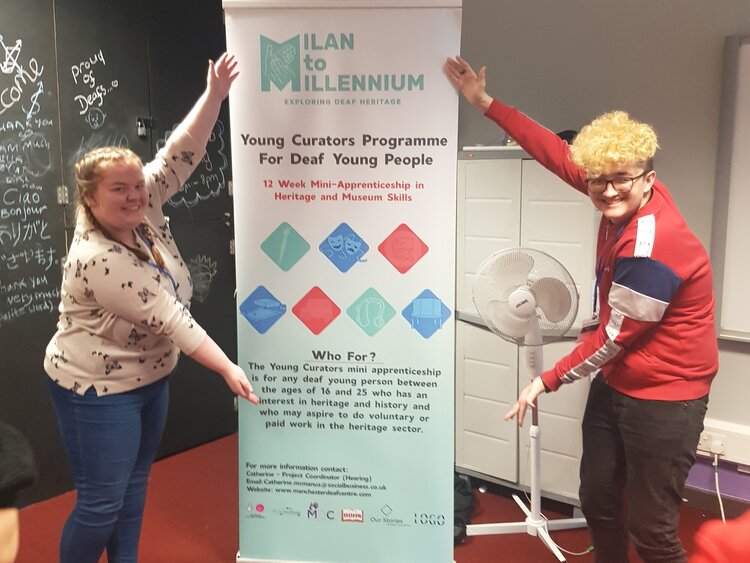
Our Stories, a UK Heritage Consultancy company worked alongside the British Deaf Museum and the Manchester Deaf Centre to secure funding for a heritage project engaging young deaf people. The aim of the project was to look at the history of deaf people from the Milan Conference in 1892 to the present day and to share this knowledge through a travelling pop-up museum, see https://www.ourstories.co/projects
Source: https://www.ourstories.co/projects
RIT/NTID Dyer Arts Center and Gallaudet University Archives
In a unique collaboration between the two largest collections of deaf art in the world, the Gallaudet University Archives and the RIT/NTID Dyer Arts Center came together to create an exhibition for our community to explore the relationships between deafness, the natural world, and the construction of personhood. It was located at a storefront in downtown Hyattsville, MD, right next to a local deaf-owned brewery. It ran from December 23, 2021 to January 15, 2022.
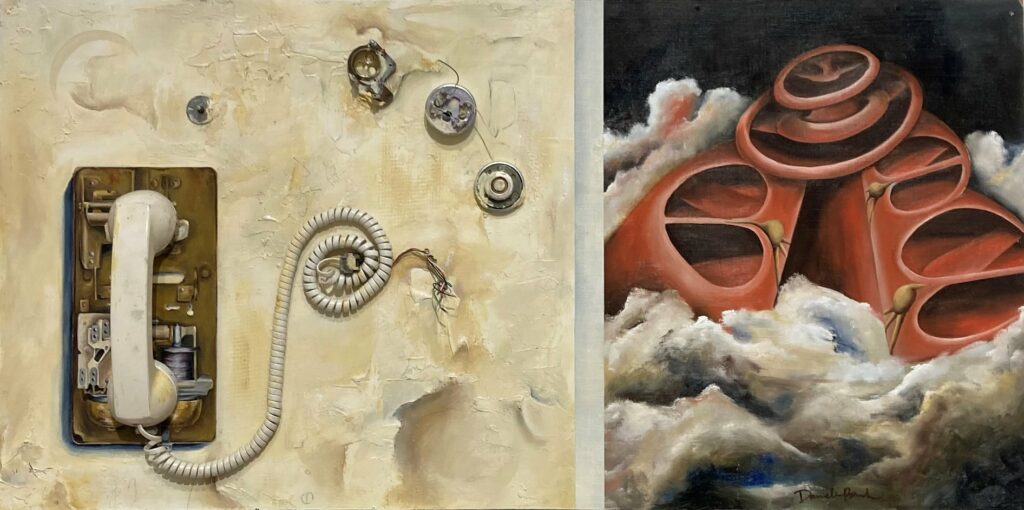
“Why,” a mixed media piece created by Danielle Burch in 2011, was one of the artworks on display at the RIT/NTID Dyer Arts Center and Gallaudet University Archives joint exhibit.
"Hands Up"

"Hands Up" in Austria has a mobile version: "Hands Up on Tour". Deaf guides travel in a pink van to schools, organisations, businesses to tell hearing people about deafness.
Correction: the pink van is only the logo! The Deaf guides travel on public transport or by car.
See https://www.facebook.com/handsupwien for recent examples of "Hands Up on Tour.
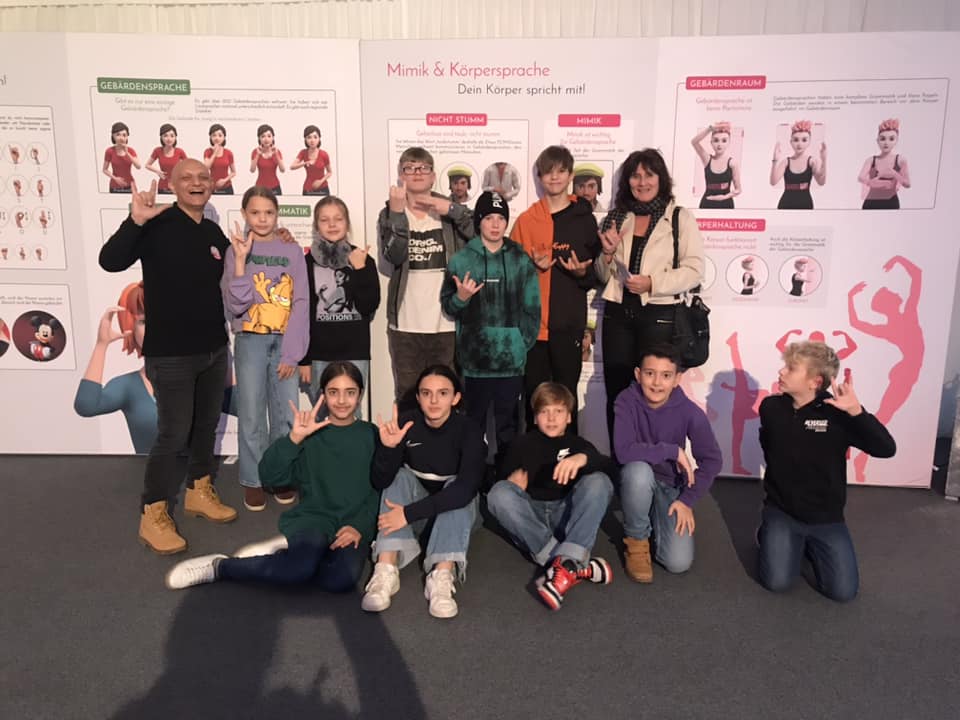
Hands Up on Tour, November 2022
Museum of Me
Museum of Me: Discovering the “Me” in Deaf Identity. Exploration Through a Museum’s Perspective - is an MA thesis by Trisha Jane (USA, 2012). The curriculum centres on the exploration of the students' own ideas of culture and identity in American Sign Language and English through several projects cumulatively representing the "Museum of Me." Based on the evidence from anecdotal notes, rubrics, checklists and student generated artefacts; the students gained in empowerment and academic security in identifying their cultural identity through sharing and linking.


